
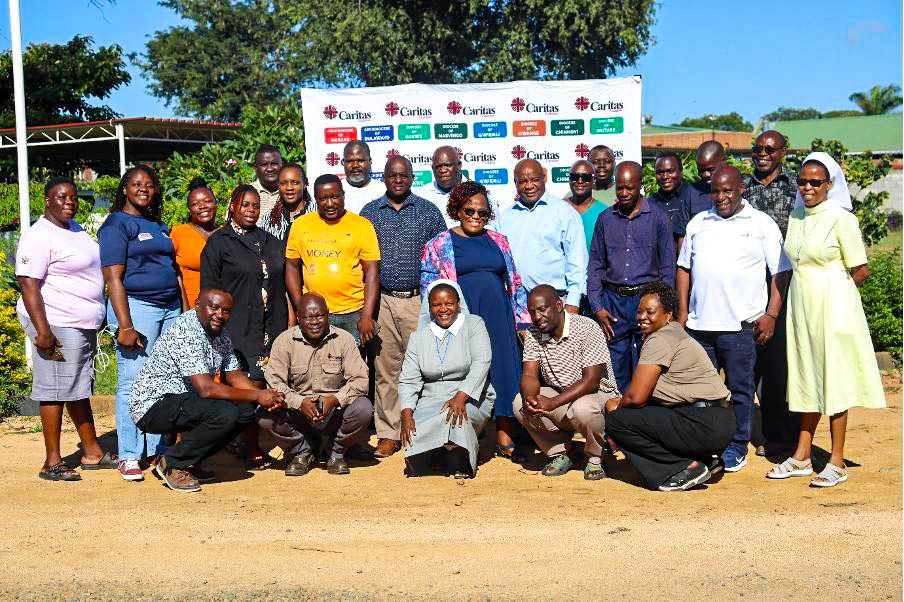
Members of Caritas Zimbabwe take a moment to pose for photo during the training.
By Pauline Chateuka
Caritas Zimbabwe, the official development arm of the Zimbabwe Catholic Bishops Conference since 1972, has walked a long journey of service marked by both resilience and challenge. Over the past five years, the shrinking funding landscape and intensified competition for humanitarian resources have placed a significant strain on the organization. This environment has increased reliance on support from Caritas Internationalis Member Organizations (CIMOs), Catholic Relief Services (CRS), the Catholic Agency for Overseas Development (CAFOD), Trocaire, Caritas Australia, and Cordaid.
In response to these realities, Caritas Zimbabwe has taken a decisive step towards strengthening its institutional sustainability. The Caritas national office convened a five day business development and quality assurance training at Emthonjeni Pastoral Centre in Parklands, Bulawayo, bringing together staff from all eight dioceses across the country. The training was made possible through financial support from Caritas Australia, CAFOD, CRS, Cordaid and Trócaire.
The training workshop officially opened with a Mass led by Archbishop Alex Thomas, Bishop President of Caritas Zimbabwe. In his homily, he empasised the issue of commitment.
“You must remain committed to reaching the most vulnerable members of society. Strong systems, ethical leadership, and accountability are essential for the Church’s social mission to deliver lasting impact”, said Archbishop Thomas
The training brought together 33 participants (20 women and 13 men), including diocesan coordinators, programme managers, finance officers, and monitoring and evaluation (M&E) officers. The objective was to strengthen resource mobilization, improve quality programming, and enhance accountability systems across the Caritas Zimbabwe network.
Setting the tone for the week, Caritas Zimbabwe National Coordinator Harrington Chuma reaffirmed the organization’s commitment to strengthening business development units (BDUs) and M&E systems in all dioceses.
“The training has come at a critical time, where Caritas Zimbabwe is beginning the implementation of its 2025–2030 strategic framework, which positions it as both a vital arm of the Church and a credible humanitarian actor”, said Chuma
Initial sessions focused on assessing organizational capacity across dioceses. Findings revealed a heavy dependency on Catholic donor agencies, with limited engagement from bilateral donors, corporate partners, and local funding sources. While proposal development capacity was rated relatively strong, gaps were identified in post award management, donor relationship management, and after action reviews. These findings underscored the urgency of strengthening systems and investing in staff capacity to enable Caritas Zimbabwe to compete effectively for diverse funding opportunities.
The training was enriched by strong technical contributions from CIMOs, whose facilitators brought practical, context specific learning drawn from their operations in Zimbabwe and globally. Shingai Nhara from CAFOD led sessions on donor pre positioning, sharing live and ongoing examples from Zimbabwe. The session sparked strong reflection.
Nqabayezwe Moyo and Edmore Chizozo from CRS guided the participants through the full proposal development journey, including Go/No Go decisions, eligibility checks, team assembly, and review processes. They also unpacked M&E systems, demonstrating how global reporting structures consolidate country level data. As a key action point, CRS committed to working with Caritas Zimbabwe National Office to develop global indicators aligned to the 2025–2030 Strategic Plan.
Tafadzwa Munyaka provided targeted support on preparing applications for European Union funding, equipping participants with practical guidance on navigating competitive donor processes. While Tinashe Zulu and Cynthia Musara concluded the training with a demonstration of a digital M&E system, illustrating how data-driven systems can strengthen accountability and learning. Following the training, Caritas Zimbabwe will work with Cordaid to develop a digital M&E system informed by the global indicators being developed with CRS.
Local fundraising and sustainability emerged as key issues during the workshop. Fr Limukani Ndlovu, Director of Emthonjeni Pastoral Centre, shared inspiring community-based fundraising experiences.
“Through initiatives such as fundraising dinners, fun runs, and volunteer engagement, we have managed to raise over US$113,000, demonstrating that local resource mobilization is achievable when transparency, trust, and community ownership are prioritized”, said Fr Ndlovu
The training marked a significant shift in how capacity building is delivered across the Caritas Zimbabwe network.